Friday, 2 May 2014

The Bee-Wolf

Philanthus triangulum

9-18mm
July to September
This wasp is a specialist predator of the Honey Bee Apis mellifera. The large females can be observed around flowers of all kinds as they stalk and grab their victim, usually whilst the honey bee is feeding. Once caught, the female bee-wolf uses her sting to paralyse the honey bee and carry it off to her nesting burrow, usually dug in light sandy soil, sand dune or even in flat sand on a beach. Each female will make one burrow, which could have several internal chambers, but many females maybe nest close to each other and this is where they are usually spotted, along with the much smaller males. The females often appear larger in flight as they carry the prey slung under the body. 

Female specimen - collected whilst still clutching Apis mellifera worker. 

Two females, showing strong variation in yellow patterning. 

Both sexes have very large heads, with clearly visible ocelli and large compound eyes.  Abdominal patterns can vary, but generally the female has smaller black triangles on each segment of the gaster, with some specimens having completely yellow gasters. Both sexes have large pale yellow or cream areas on the face, and large jaws, especially in the female.

Specimens still in mating posture. Male is much smaller and shows the typical yellow facial markings.


Face of the female bee-wolf, and above, the large jaws and ocelli. 

Other readily identifiable characteristics include: 
- Antennae are stout and thickened towards the middle.
- Females often have red or orange pigmentation behind the eyes and on the forelegs.
- Forelegs of female have combs for shifting sand and soil.
- Bee-wolves can also be found taking nectar from flowers such as creeping thistle and bramble blossom.
Once rare in Britain, now fairly common in localised areas of south-east England, especially in coastal ranges but also found in forests, suburban and urban settings.

two males, showing typical darker form than females, although females can sometimes be very black. 


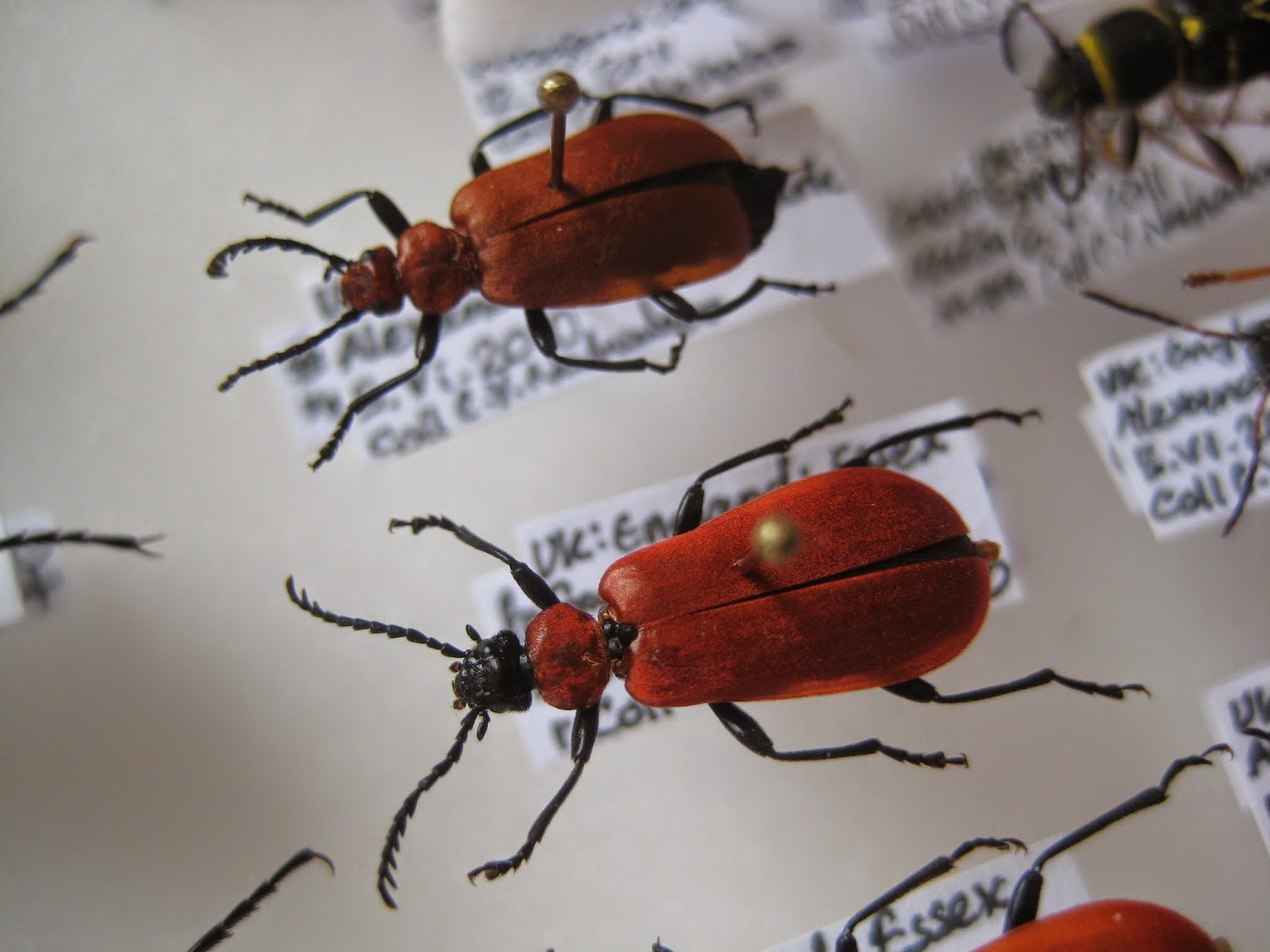
Cardinal Beetle

Pyrochroa coccinea

17-21mm
Late April to July
The vibrant velvety red elytra and pronotum make this beetle stand out when at rest on tree trunks or feeding at flowers. The large flattened larvae live under loose bark where they predate smaller invertebrates. The larvae are easily recognised by the sturdy forked projection at the tail end. They remain under the bark to pupate and emerge as adults in late spring.
The head and serrated antennae are black, as well as the legs and underside. The hind-wings are also very dark and the beetle flies regularly in the sun across woodland paths.


Both sexes look very similar, but females are often slightly broader. The elytra are fairly soft and flexible.
When handled or alarmed the cardinal beetle will emit a pleasant sweet odour.
Fairly common and widespread in southeast England and Wales, occurring most frequently in deciduous forest and parkland.
P.serraticornis (top, in the photo above) is the most similar species but easily distinguished by its red head, and the overall colour is often more orange than the vivid crimson of P.coccinea.


Bagworm Moth caterpillar

I recently found an odd creature which at first glance looked like a moving lump of bark or lichen...

After a bit of googling I have realised it's a 'Bagworm' larvae, belonging to the moth family Psychidae. These larvae are quite similar to caddis fly larvae, in that they collect tiny fragments of debris from their surrounding area and weave a protective case to cover their soft body. The one in the photos is around 11mm long, and is the first one I have ever seen, so not sure about species yet. It seems to be feeding on moss and maybe some sort of lichen in the bark, although I can't see it, so must be eating really tiny amounts of whatever it is!


Amongst the debris on it's back, there is a small exuvia from the headcase (I think!).... I think this could be used to maybe ID the specimen, but the photos aren't great... will probably be easier to see what kind of moth it turns into....


Friday, 25 April 2014

Insects on the head of a Hare....

Last Sunday a country walk in Norfolk turned up a very interesting find...


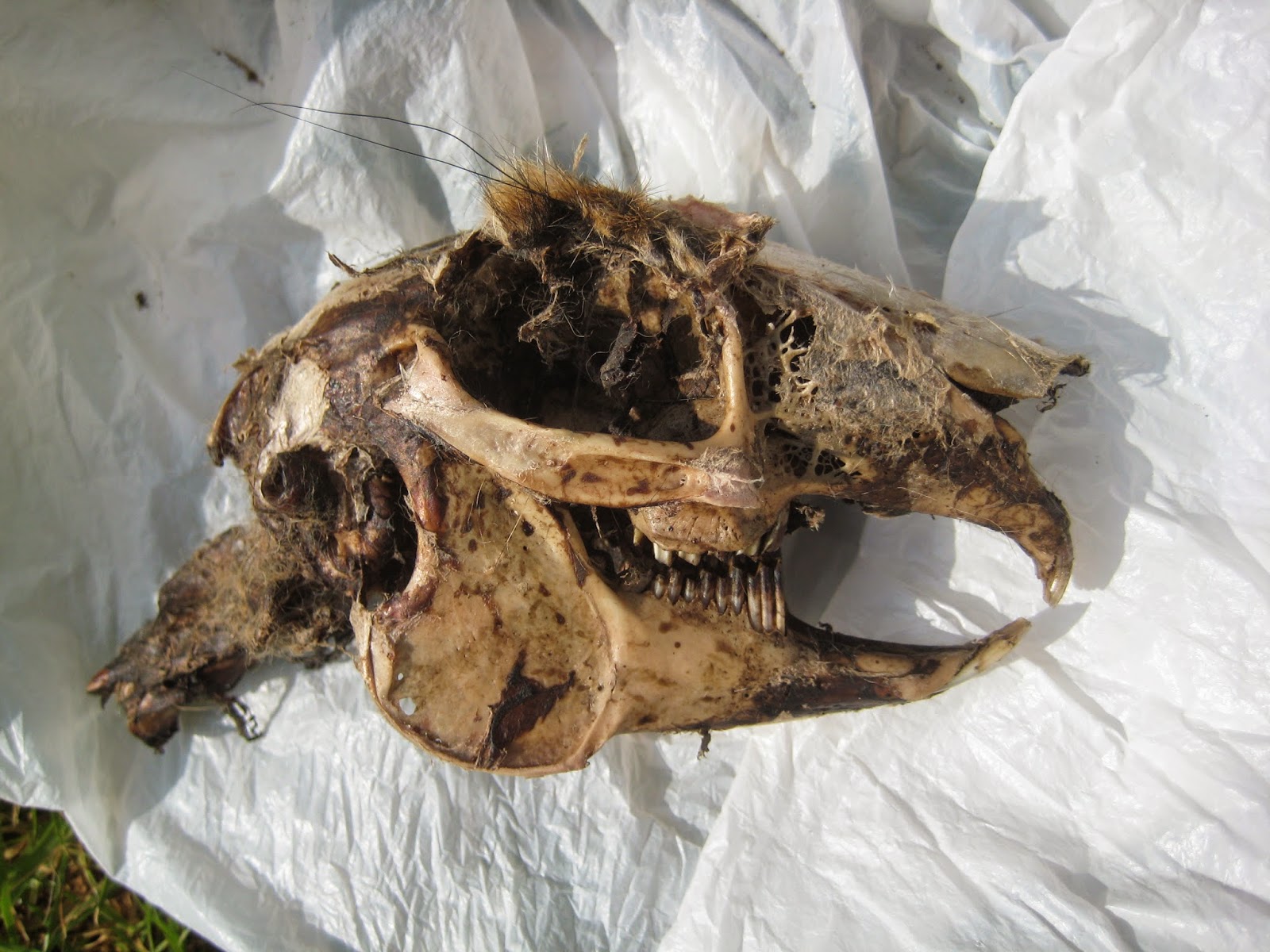
There was an old dead Hare in a ditch beneath some bushes, so being a keen skull collector  went down to take a look. Most of the flesh had already been eaten, and what was left was very dry and there was no smell, so unfortunately it was far too late for any of the Sexton Beetles, but I did find one adult Oiceoptoma thoracicum, which was great as I had never seen this species before.

Oiceoptoma thoracicum - pinned and drying out, 
the pins around it are to hold things in place.

Once I had a closer look at the skull and started the cleaning up process, I found lots of small beetle larvae. These are all Silphinae larvae, but I will have to wait for some to mature and develop into adult beetles before I can confirm the species. The wider looking larvae in the middle  is a young Oiceoptoma thoracicum. I have kept the larvae in a tub with substrate and food, so will hopefully have adult beetles soon...


For those of you also interested in the Hare skull itself, it's almost fully clean, so will post about it when there is progress, this is what it looked like after initial cleaning:


Thursday, 24 April 2014

Giant Black Tachinid

Tachina grossa

15-22mm
May to late August
This large bulky fly is often mistaken for a bumblebee at first glance – especially in flight. Fairly frequent where it occurs, but localised to heathland and downland where the host species are found. 

Male specimen, found on downland on the Isle of Wight

The larvae burrow into the caterpillars of large moths, often of the Oak Eggar, where they parasitize the host – feeding and developing within. Adults are most often seen in bright weather, feeding at umbellifers, creeping thistle and other wildflowers, or basking on bramble foliage.


Profile and Ventral views of a Male specimen

Both sexes are very similar – huge rounded black body covered in bristles, yellow or cream face with brown eyes and a yellow ‘collar’ of fur behind the head.
Wings have a clouded yellow region at their base.
Legs are black and bristly with large yellow pulvilli (foot pads).

Can exhibit aggressive or territorial behaviour towards smaller flies whilst feeding at flowers.


 Male specimen above, and much larger Female below


Tachina grossa hand drawn illustration,
pigment liner, markers, watercolour pencil & ink, A4
Prints available, signed and numbered limited edition.


An Illustrated diptych featuring Tachina grossa can be seen here, based on religious icons and sacred connotations:
https://www.flickr.com/photos/insectopolis/11187636574/

Bloody Nosed Beetle & Lesser Bloody Nosed Beetle

Timarcha tenebricosa
Bloody-Nosed Beetle
12-22mm
April to early August
Slow moving rounded beetle feeding on bedstraws in the Galium genus. Named for the habit of exuding drops of red liquid from the mouth when alarmed. Most often seen on the stems of bedstraw or walking at the edges of country and coastal footpaths. Usually in rough areas of low vegetation and on downland, appearing more frequent in southern coastal regions.


Male & Female found mating on bedstraw


Common, but can be difficult to spot as they are most active at night.
The elytra are fused and the entire body has a strong blue or purple iridescence.
Females usually larger than males - males with much larger tarsal pads on the feet – used to grip the female carapace during mating (as seen in the photos above).
Females lay eggs in small groups on the leaves or stem of bedstraw in spring, and the larvae remain on the plants feeding until September when they mature and pupate.
Larvae are also blue-black and very rounded with a segmented body.

Timarcha goettingensis
Lesser Bloody-Nosed Beetle
8-12mm
April to early August
Very much like a small version of T.tenebricosa with a slightly rougher, pitted surface texture.


Often abundant in large numbers with many mating pairs in localised areas of downland – more frequent in coastal areas. Adults and larvae feed on small members of the bedstraw family and other low growing plants. More likely to be seen on very short grassland than T.tenebricosa where they can appear like rabbit droppings at a glance.


Flightless with fused elytra.

Females larger and rounder than males. Males with larger feet. Both sexes are often more strongly blue or purple than T.tenebricosa

Comparison of T.tenebricosa and the much smaller T.goettingensis

Oil Beetle

Meloe proscarabaeus

18-40mm
March to early June
Large flightless beetle, most likely to be encountered along coastal paths including cliff-tops. Named for the ability to exude a yellow or orange oily liquid from the leg joints. Oil Beetles occur only in areas with a good mix of wildflowers and solitary mining bees, but in these areas can be very frequent when the adults emerge in spring – sometimes up to ten beetles being seen in a two metre stretch of path, but always very localised. The females are much larger than males, with gravid abdomens. 

Large female - Coastal cliff path, Isle of Wight. April

The male antennae exhibit a very noticeable cupped section about halfway along their length, and the abdomen often tapers more than the blunt tail end of the female.
Adults are black with a blue sheen and pitted texture all over the head thorax and elytra.

 Three females and smaller male below


Each female can lay around 1000 eggs which she deposits in a burrow. The fast moving hatchling larvae are known as Tringulins and clamber to the tops of flowers in vast numbers to hitch a ride on various solitary bees. Once taken back to the nest burrow of the bee, the larvae develops into a more grub-like, typical beetle larvae, feeding on the eggs and pollen stores of the bee. 

 Very large female, just over 40mm long


When the mature larvae pupates it will remain hidden within the host’s burrow until the following spring. When the adults emerge they feed on the foliage of various low growing plants. A similar species is M.violaceus, which has a stronger blue sheen, more finely pitted texture and is found in a wider northern area than M.proscarabaeus

Spot the male and female!
This pair had been mating by the side of a coastal path, April 2014
Within a few feet, there were at least 9 others, and one crushed on the path